CENTER FOR THE PROFESSIONAL EDUCATION OF TEACHERS
  • Home
  • Who We Are
    • Our Team
    • Our Partnerships
    • Our Authors
    • In the News
    • Principles of Practice
    • Job Opportunities
  • What We Do
    • Services
    • Equity in Action
    • Signature Initiatives >
      • Literacy Unbound
      • New Teacher Network
      • Student Press Initiative
  • Educator Essentials
    • New Teacher Mentoring
    • Online Courses
    • Professional Articles
    • Ready-to-use Resources
    • Teaching Today Podcast
  • Support CPET

10/8/2019

Checks for Understanding: Helping Students Overcome Academic Obstacles

Comments

Opportunities for micro assessments that ensure students are developing the skills needed to overcome academic obstacles.
Picture
DR. ROBERTA LENGER KANG
Center Director, CPET

We often think about learning like a marathon, as if it's this long, long race where everyone begins at the same starting line, sets their pace, and runs at that pace for a long time until they arrive at the finish line. But there’s a problem with this analogy. The problem is that learning does not typically happen in consistent, incremental stages. Instead, learning happens in fits and starts, and in the best situations, it is the result of being deeply curious about a subject, topic, or theme and engaging in a productive intellectual challenge. In fact, when we really get down to it, learning isn’t like running a marathon at all! If learning is like running, then it’s probably a lot more like jumping hurdles.

When jumping hurdles, runners begin at the starting line and then sprint as fast as they can towards the first obstacle they have to overcome. If they’re successful, they continue to sprint forward. If they are not successful, the hurdle falls down, or worse — they fall down. Then they have to pick themselves back up and start again. Runners who can overcome all of the hurdles sprint through each stage on the track. Runners who cannot fall behind abruptly, and sometimes, permanently. 

To train runners in hurdles, coaches help them practice by providing a set of smaller obstacles along the track, and train them through practice sessions where they develop specific strategies that will refine their skills. Coaches watch the moves the runners make while they’re jumping, and study these moves to give the runners actionable feedback about ways they can adjust their footing, their stance, and their speed — all of which help them to become better at the sport. This is the same kind of training and support that checks for understanding provide for students. 

Micro assessments

Checks for understanding are micro assessments that teachers can build into their lessons to ensure that students are developing the strength, skills, and strategies necessary to overcome the academic obstacles that will be presented in a long-term project, assessment, or high-stakes test. They are mini-hurdles that can help a teacher determine which students are sprinting ahead, which have minor gaps in understanding, and which are struggling to make sense of the lesson content or skills. 

Traditional instruction organizes the procedure of a lesson so that the teacher presents on the important topic of the day, the students engage in practice related to that topic, and then go home. Everyone holds their breath and hopes that the students do well on the quiz at the end of the week. In our analogy, this model would be equivalent to a coach turning away from a race, hoping their runner is able to finish. Students, like runners, need three things from their teachers to increase their speed, strength, flexibility, and stamina. 

1. Tasks that gradually increase in difficulty
Like a coach who lays out smaller hurdles on the track to teach runners about basic techniques, teachers can provide short tasks for students at strategic points in a lesson. One simple structure for a lesson would be to include one check at the beginning of the lesson, one in the middle, and one at the end of the class period. The opening check serves as a baseline understanding of what students remember from a previous lesson, and assesses their prior knowledge or current thinking about a topic. The mid-lesson check becomes a moment to micro-assess their understanding of the essential learning of the lesson. What must students understand in order to meet the learning target or objective? Finally, an end of lesson check gives us vital information about how students are leaving the class. This check informs our instruction for the next day’s lesson. 

2. Actionable feedback for micro adjustments
We often assume that assessments always equal grades. But just like not all runs are races, not all tasks need to come with the heavy weight of a graded assignment. Small and simple assessments designed as checks for understanding provide key insights into students’ knowledge while it’s in formation. This is critical to helping teachers understand how students are making meaning, as well as how they’re interpreting (or misinterpreting) the content. Rather than focusing on how many points to provide, consider ways of providing students with actionable feedback that includes micro adjustments. Micro adjustments may include offering students a suggested next step, pointing out something they did well, or giving a tip as to what would have made their response more complete. The goal is to move away from evaluative feedback like “good job” or “needs work” and move into actionable feedback, which gives students a concrete next step to practice. When we get good at building checks for understanding into our lessons, we can design our lesson sequence to build on the feedback we give students in the moment. 

3. Celebration of progress
As many runners can attest, marking personal progress is critical to building confidence even when someone else crosses the finish line first. As educators, it is essential that we are able to note specific areas of improvement for students at all levels. We can make connections between their gains and future successes, which increases their investment in their learning and can help them to set short- and long-term goals. 

Getting started

There is no shortage of strategies for checks for understanding. Below is an example of one of our favorite sequences using US Government as an example topic. 
Beginning of lesson
3 - 2 - 1
Encourage students to respond to a 3 - 2 - 1 prompt on a topic previously studied (yesterday’s lesson) or a topic or theme that the class is preparing to explore. 3 - 2 - 1 is easy to customize. For example, a 3 - 2 - 1 on the topic of monarchy might look like this:

3 facts:  We have three branches of government. The are equal to each other. One of them makes the laws. 
2 questions:  Why don’t we have a Queen or King? What is the difference between the Senate and the House?
1 Opinion: Is the US Government the best system in the world?
Mid-lesson
Hingepoint questions
​A hinge-point question is a multiple choice question with one correct response and three purposeful incorrect responses. Each response reveals some information about students’ thinking or reveals a misunderstanding. Based on how students respond to the question, they can be sorted into different work groups or stations to deepen their thinking and move into more challenging tasks.

Ex: In the three branches of government, who makes the laws? 
A. The House
B. The President
C. The Congress
D. The Supreme Court
End of lesson
The most important thing...
Students respond (in approximately three sentences) to the prompt: The most important thing I learned today was . . . it is important because . . . in order to remember this I am going to . . . 

There are countless ways to monitor our students’ learning. When we are engaging in beginning, middle, and end of lesson checks for understanding, we have so many opportunities to notice our students’ process and progress, to reflect with them, to encourage them, and to help them leap over the obstacles they encounter on their learning journey.
Comments

10/4/2019

Exit Tickets as Formative Assessments

Comments

Exit tickets allow you to breathe for a couple of minutes before your next class period starts. 
Picture
G. FAITH LITTLE
Initiative Director, 21st Century Learning

An exit ticket is like an Instant Pot. You hear about how great it is — it saves time, it’s simple, it’s flexible, and it doesn’t need many ingredients. It seems to be a staple tool at this point, so you pick one up and start using it. So it goes with exit tickets. When we start using them, it may be because of both convenience and necessity. They’re quick and easy, and they allow you to breathe for a couple of minutes before your next class period starts or you need to switch over to the next subject you’re teaching.

Exit tickets also provide a supportive rhythm to your class. They signal to kids that they will be transitioning soon, and this is invaluable to many students — especially if they struggle with change during their school day. Exit tickets provide a natural way to move from one space into the next, figuratively (if students stay in the same classroom) and literally (if students move to a new room). 

Sometimes that’s as far as we get with using exit tickets. It feels like enough, especially at the start of the school year or in the first year of your teaching career. But we can improve our use of exit tickets by taking them from simple (and valuable!) classroom tools and morphing them into invaluable formative assessments. 
“The power of exit tickets lies not only in informing instructional decisions — it includes the public acknowledgment of students' ideas and making adaptations of lessons, based on these responses, transparent to students (Marshall 2018). Importantly, exit tickets can also give voice to students who are otherwise silent in class, including English language learners and students "on the margins" of classroom life, and can draw your attention to who is being served in which ways, giving you critical information for shaping your practice to enhance equity and inclusivity.” 

— Exit Tickets: Understanding students, adapting instruction, and addressing equity (source)​

What is an exit ticket? 

Backing up for a minute, let’s define an exit ticket. An exit ticket is a task that typically requires a short response from students. Teachers use exit tickets after an activity or learning period, and it can literally be the ticket to exit the room at the end of a period or a way for students to exit a part of the lesson. Exit tickets are not graded. Because they are not associated with a grade, students take on very little risk and can be honest about what they do and don’t understand, and may be more likely to ask questions they wouldn’t on a graded piece of writing. 

Using exit tickets as formative assessments

Exit tickets can be used in any subject area at any grade level as formative assessments to provide teachers with authentic data, in real time. 
“To be effective, an exit ticket should have specific prompts for students and take only about five minutes to complete. Students can record their responses on index cards, sticky notes, notebook paper, or online (e.g., Google Forms, Padlet, Schoology, etc.). Ideally, student responses inform the next stages of learning by highlighting whether teachers should clarify ideas, reteach them, extend them, offer practice, introduce new ideas, or restructure future instructional activities (Marshall 2018).”

— Exit Tickets: Understanding students, adapting instruction, and addressing equity (source)​
Making exit tickets your own means designing (or using templates) for short responses that you can read fairly quickly. This can be as simple as a sticky note on which students respond to a prompt with a few words or a What, So What, Now What chart. 
What
So What
Now What
What happened?
What does that mean? 
Now what will you do with this information?

​​At the end of a day, class period, or activity, you can engage in a quick cycle of inquiry with the data. 
Picture
1. Sort the data based on your own criteria from the lesson or for your specific students.
  • Example: students who demonstrated they understand the concept, students who demonstrated they somewhat understand, and students who provided no evidence of understanding.

2. Examine each set of data. What do you notice? What needs attention?
  • Example: a third of the students mentioned key terms from the lesson. 

3. Identify areas that need to be taught, retaught, or further investigated.
  • Example: need to revisit primary colors

4. Adjust your next lesson to accommodate your findings.
  • Example: start tomorrow’s lesson pairing students to share their knowledge

5. Revise your next exit ticket (if needed)  if you see that your prompt isn’t yielding useful data.
  • Example: “Did you learn what osmosis was?” didn’t show me what they knew, only if they thought they learned the concept. Revise to an open-ended prompt.

​Using exit tickets as formative assessments is a promising practice that can be quick and can also support deep and differentiated learning in your classroom. Share with us your exit ticket practice below. Similar to Instant Pots, when you learn new ways to use them, it’s fun to share your findings with others!
Comments

6/11/2019

Behavior as Data: What Are Your Students Communicating?

Comments

Engage in low-inference observations that can lead to new discoveries about your students' needs.
Picture
G. FAITH LITTLE
Initiative Director, 21st Century Learning


Behavior is a form of communication.

Plug this sentence into your preferred search engine, and it will return enough results to keep you reading for hours. Since it’s more likely you’re scrolling through this post on your train ride, between classes, or at lunch than sitting with a cup of tea and hours to spare, let’s connect the dots quickly and consider a way to look at communication through behavior as data that we can analyze to determine a productive possibility in our classrooms.

Collect the data: what is the behavior?
Start with documenting low inference observations of behavior. As you jot down the description of the behavior, challenge yourself to write only what is observable. When you write, “a fight broke out,” ask yourself, “what did I actually see?”.

What did you see? What did you hear?

It’s worth the time it takes to develop your low inference observation skills, because you will be working from more accurate data, as free of assumptions as possible.
High inference
Low inference
A fight broke out
​Two students [names] stood up and walked toward each other. The first student was standing between the door and the second student. The first student said something that I couldn’t hear. The other student took a deep breath, stepped forward. The first student said, “What are you going to do?” The second student stepped to the left and forward and the first student moved in front of the second. The second student put their right hand out, pushing the first student, and then walked quickly to the door, pushed it open and left. The first student stumbled backward. I told the student to sit down, and he walked back to his desk and sat in his chair. 
He was upset
He raised his voice above his usual speaking voice and said, “I’m not going to,” and then he put his head down on his desk.
She couldn't control herself
She continued playing after I counted to three. I said, “That was the final warning,” and she stood up, looked at me, and started crying. ​

Analyze the data: what might it mean?
While you already have classroom expectations clearly outlined and students may be fully aware of the consequences of certain behaviors, whether it is a phone call home, a visit to the AP, or other intervention, you may also consider using a tool to support your own problem-solving. This is especially helpful when you’re confronted with a persistent, or even new, behavior. 

Lifelines is a tool we’ve used with our partner schools when looking at data reports together. With a few customizations, we can use this tool to explore behavior as data.

  • What is the behavior? This is your low inference observation. Consider remaining curious about this behavior and what it may be communicating as you move forward.
  • What might it mean? This is where you bring in your understanding of the student, their context, their story. Is there information you may be missing? Who else do you want to talk with in order to get a more complete picture that could inform your analysis?
  • Why is it important? You considered this behavior important enough to analyze for a reason. What else have you discovered during your analysis that makes this behavior important to address?

​Consider possibilities: apply analysis to inform instruction
What questions, lessons, or interventions make sense to support the student and their learning? Is it an individual moment that is needed or could the whole class benefit from some time investigating this issue together? 

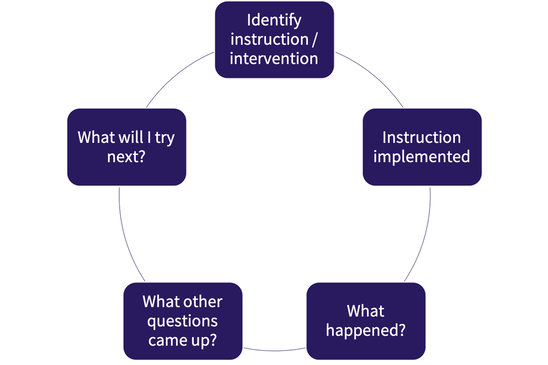
Try your lesson or intervention out. What happened? What other questions came up? What might you try next? If you continue to remain curious, your “final” determination in the Lifelines tool can be a starting point to a simple cycle of inquiry.
Picture

By engaging your curiosity and making low inference observations of student behavior, you can engage in an inquiry cycle that could result in new and exciting discoveries about what your students’ behavior is communicating. Your findings can then support students academically by addressing their social-emotional needs.
Comments
Forward>>
    ←  BACK TO ALL ARTICLES

    Picture
    SEARCH BY TOPIC
    21st century skills
    Adult learning
    Assessment & testing
    Classroom culture & SEL
    Classroom management
    CRSE / CRSP
    Curriculum
    Data-driven instruction
    Growth & goals
    Leadership & teams
    Literacy
    Project-based learning
    Rigorous instruction
    Student engagement

    Picture
    Picture
    Picture
    Picture
    Picture

    Picture
    Get started
Picture
The Center for Professional Education of Teachers (CPET) at Teachers College, Columbia University is committed to making excellent and equitable education accessible worldwide. ​CPET unites theory and practice to promote transformational change. We design innovative projects, cultivate sustainable partnerships, and conduct research through direct and online services to youth and educators. Grounded in adult learning theories, our six core principles structure our customized approach and expand the capacities of educators around the world.

ABOUT US

525 West 120th Street, Box 182
New York, NY 10027
​416 Zankel

Ph: (212) 678-3161
[email protected]

Our Team
Career Opportunities
EDUCATOR RESOURCES

Book of the Month
Online Courses
Professional Articles
Ready-to-Use Resources
Teaching Today Podcast
COACHING SERVICES

Custom Coaching
Global Learning Alliance
Literacy Unbound
​New Teacher Network
Student Press Initiative
MAKE A DIFFERENCE

​​Every gift is an investment in equitable education. With your support, we can continue to bring transformative change for K-12 teachers, leaders, and students worldwide. 
Donate

  • Home
  • Who We Are
    • Our Team
    • Our Partnerships
    • Our Authors
    • In the News
    • Principles of Practice
    • Job Opportunities
  • What We Do
    • Services
    • Equity in Action
    • Signature Initiatives >
      • Literacy Unbound
      • New Teacher Network
      • Student Press Initiative
  • Educator Essentials
    • New Teacher Mentoring
    • Online Courses
    • Professional Articles
    • Ready-to-use Resources
    • Teaching Today Podcast
  • Support CPET